
HDD Drilling for Multifamily Fiber Installation: Why Expertise—Not a Phone Call—Protects Your Property
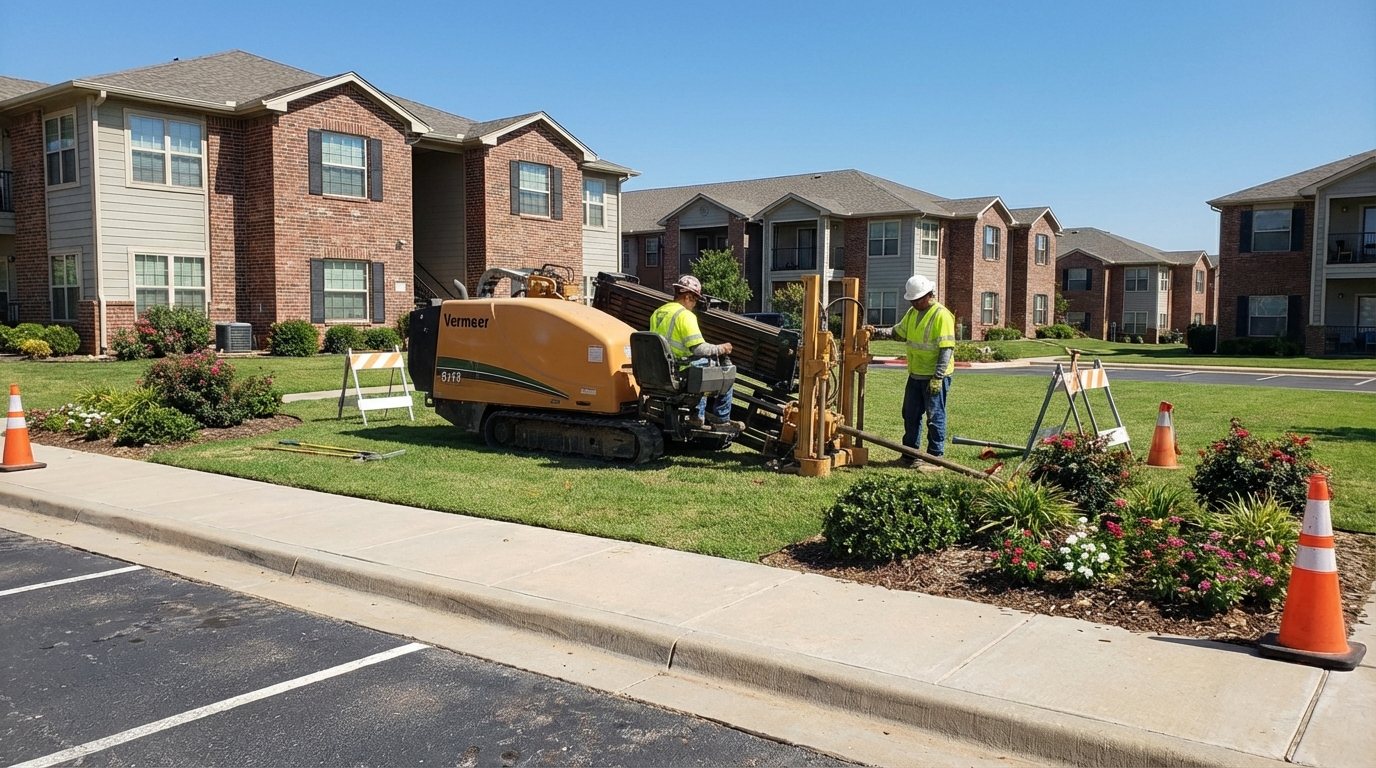
Horizontal Directional Drilling (HDD) for multifamily fiber installation is a trenchless boring method used to route HDPE conduit beneath driveways, parking lots, landscaping, and hardscape on apartment communities without surface excavation. This guide covers HDD drilling practices for both new construction and existing multifamily properties, including garden style apartment communities where outside plant fiber runs between buildings across private ground. Topics include Fiber to the Unit (FTTU) vs. Fiber to the Building (FTTB) architecture, private utility locating requirements, ground penetrating radar (GPR), potholing, 811 limitations on private property, and why expertise in multifamily HDD drilling — not a phone call to a one-call center — is what protects properties from utility strikes, cost overruns, and construction delays.
When a multifamily property owner agrees to a fiber installation, what they are really agreeing to is a carefully managed underground construction project. Most never think of it that way—and that gap between expectation and reality is where projects go sideways, budgets blow up, and landscaping gets destroyed.
Horizontal Directional Drilling (HDD) is one of the most powerful tools in a fiber installer's toolkit. It is also one of the most consequential. Done right, it gets HDPE conduit under driveways, parking lots, mature landscaping, and walkways without a single shovel cut or surface scar. Done wrong, it punches through a gas line, clips a private irrigation main, or severs an unmapped copper water line—and suddenly you have a project shutdown, a cost overrun, and a furious property manager.
This post covers how fiber HDD drilling actually works in multifamily environments, why it is different on new builds versus existing properties, how Fiber to the Unit (FTTU) and Fiber to the Building (FTTB) architecture affect your conduit routing decisions, and—most critically—why professional private utility locating is not optional. It is the difference between a clean project and a catastrophic one.
A note on property type: This guide is most relevant to garden style apartment communities—properties where buildings are spread across a site and outside plant work runs between structures across common ground. Midrise and highrise properties, by their nature, consolidate infrastructure vertically and have significantly fewer private drilling needs. Some drilling may be required to reach the right-of-way or the property demarcation point regardless of property type, but the private HDD work this guide addresses is primarily a garden style challenge.
HDD Drilling in Multifamily Fiber Installation: What It Is and Why It Matters
Horizontal Directional Drilling is a trenchless construction method that bores underground pathways for conduit without disturbing the surface above. A drill rig drives a steerable drill bit from a launch pit, tracking its path with a locating wand and receiver system, and navigates under obstacles that would otherwise require full excavation. When the bore path is complete, the drill bit is detached at the exit point and replaced with a pull-back attachment—typically a conduit sock or similar fitting—which is connected to the HDPE conduit and pulled back through the completed bore as the drill retracts from exit to entry.
For multifamily fiber installation—whether a new construction build-out or a retrofit of an occupied existing community—HDD solves a fundamental problem: you need to get conduit from a building to a property edge, across a parking lot, under a road, or beneath landscaping that cannot be excavated without significant cost, damage, and disruption. Trenching alternatives are slower, more invasive, and on occupied properties, they are often not viable at all.
Equipment scale matters on multifamily sites. Large HDD rigs are built for open utility corridors and ROW work. On a garden style multifamily property, the drill paths often run through tight courtyards, between buildings, alongside irrigated landscaping, and under mature tree canopies. Compact and mini HDD equipment is frequently the right tool for these environments—smaller footprint, less surface staging area required, more precise navigation in confined spaces. A crew experienced in multifamily outside plant work will carry the right scale of equipment for the site. A crew that only runs large utility bores will struggle to operate cleanly in a residential setting.
In a typical multifamily fiber deployment, HDD is used to:
-Route conduit from the property demarcation point to central distribution equipment rooms
-Cross parking lots and driveways to reach individual buildings
-Navigate under irrigation systems, sidewalks, and common-area hardscape
-Connect remote buildings to the central fiber distribution network
The end goal is a buried HDPE conduit pathway that protects the fiber itself from damage, allows future fiber -pulls without excavation, and delivers connectivity to every building and ultimately every unit—the infrastructure foundation for enterprise-grade WiFi in a high-density residential environment.
New Builds Versus Existing Properties: Not the Same Job
New construction fiber installation is a fundamentally different engagement than retrofitting an existing property, and the HDD approach reflects that.
On a new build, underground work happens in coordination with general contractors while the site is active. When dry utility coordination is handled correctly—scheduling fiber conduit installation alongside other underground rough-in work before landscaping, hardscape, and driveways are completed—boring may not be required at all. Conduit can be trenched and placed in open ground during the construction window, eliminating the need for directional drilling on those runs entirely. The cost and complexity difference between open-cut installation and HDD is significant, and experienced outside plant teams know how to leverage that coordination window. The property is a blank canvas with known infrastructure because everything was just installed. Bore paths, where they are required, are shorter, obstacles are fewer, and the ground has not had decades to accumulate unrecorded private lines, irrigation repairs, and utility modifications.
On an existing multifamily property—the retrofit scenario—none of those advantages apply. The ground holds everything that has been installed, repaired, modified, and sometimes abandoned over the life of the property. Original as-built drawings, if they exist at all, rarely reflect what is actually underground. Irrigation systems have been repaired by plumbing contractors who did not document the work. Previous owners added utilities. Emergency repairs were made without permits. Copper water lines, gas lines, electrical conduit, irrigation mains, and drainage infrastructure all coexist in the same soil, and in many cases, nobody alive knows exactly where they run.
This is the environment where HDD drilling happens on a retrofit. For owners navigating infrastructure investment decisions in 2026's market environment—including the $1.62 trillion refinancing wave putting pressure on existing asset performance—understanding that outside plant execution quality directly affects project outcome and total cost is not optional reading. See The $1.62B Refi Crisis: 3 Scenarios MDU Owners Won't Want to Miss for context on why operators are making infrastructure decisions now rather than later.
The approach to locating and clearance on retrofit projects cannot be treated as a formality.
The 811 Problem: Why Calling 811 Is Necessary but Not Sufficient
In the United States, 811 is the national "Call Before You Dig" utility notification system. Before any excavation, contractors are legally required to call 811 and request that public utilities mark their lines. Gas companies, electric utilities, water municipalities, and telecom carriers will send locators to mark their underground infrastructure within the required notification window.
Here is what most property owners—and many contractors—do not fully understand: 811 only marks public utility infrastructure. Those companies mark their lines typically up to the meter or the property boundary. Everything beyond that point is the property owner's responsibility.
On a multifamily property, that means: private irrigation and sprinkler systems are not marked. Privately-owned underground electrical conduit is not marked. Water and sewer laterals from the main tap into individual buildings are not marked. Gas pipes after the meter are not marked. Building-to-building utility runs inside the property boundary are not marked. Texas 811 is explicit: utilities running from the meter onto private property are expressly excluded from the public marking obligation—the excavator bears full responsibility for locating and marking all private lines independently. Colorado 811 states the same: customers own all utility lines after the meter, including electric wires, gas pipes, water lines, and phone cables.
On a multifamily property, the majority of what matters underground is private.
Some HDD operators take what could be called a "rip and roar" approach: call 811, wait for public utility clearances, and start drilling. When something gets hit that 811 did not mark, the response is a shrug—"It wasn't marked, so it's not my fault." That liability deflection may hold up in some contractual contexts, but it does not fix the broken irrigation main, does not restore the damaged gas line, and does not protect the resident community from the disruption that follows.
A professional approach to multifamily HDD drilling does not treat 811 clearance as the finish line. It treats 811 as the starting point.
Private Locating: What Professional Clearance Actually Looks Like
Private utility locating is the process of identifying and marking underground infrastructure that 811 will not and cannot flag. It requires specialized equipment, trained personnel, and in many cases, domain expertise specific to what is in the ground.
Our approach to private locating combines multiple methods and does not begin drilling until confidence is established across the full bore path.
Ground Penetrating Radar (GPR)
Ground penetrating radar is a geophysical method that uses electromagnetic pulses transmitted into the ground to detect subsurface features and structures by analyzing the reflected signals that return to the surface receiver. When pulses encounter boundaries between materials with different dielectric properties—pipes, voids, conduit—they reflect signals back, which software converts into real-time 2D subsurface profiles showing depth, direction, and approximate size of underground features without breaking ground.
GPR detects both metallic and non-metallic utilities, which makes it valuable on properties with PVC irrigation lines that electromagnetic locating cannot trace. It is particularly effective on paved surfaces. Its limitations are real—saturated soils, high clay content, and deep targets can reduce resolution—but it is an essential first layer of detection on any serious multifamily HDD project.
Non-Electromagnetic and Electromagnetic Locating
Traditional utility locating relies on electromagnetic (EM) frequency induction—applying a signal to a utility via direct connection or induction and tracing that signal with a handheld receiver. This works well for metallic lines that can carry a signal: copper water and gas lines, metallic conduit, tracer-wired utilities.
Non-EM locating methods address what electromagnetic detection cannot capture: PVC irrigation lines, non-metallic conduit, and any utility that cannot carry a locating frequency. A combination of both techniques, paired with site knowledge and records review, gives the most complete picture of what is underground.
We deploy locating approaches across a full spectrum—from methodical, low-disturbance techniques to more aggressive induction methods when subsurface conditions or obscure infrastructure require it. The right tool set depends on the specific site conditions, not a default methodology applied regardless of what the property demands.
Potholing to Confirm
Locating equipment tells you where a utility probably is. Potholing tells you where it actually is. After private locates identify a conflict zone or a utility crossing the intended bore path, we use vacuum excavation or hand potholing to expose the utility at that point—putting eyes on it before the drill ever gets close. Once the depth, direction, and clearance of a known utility is confirmed visually, the driller can navigate the bore path precisely over or under that obstacle with confidence that the locating data is accurate. On complex sites with multiple utilities in proximity, potholing is not optional—it is the step that converts a probable bore path into a confirmed one.
On-Site or On-Call Plumbing and Copper Expertise
One of the most overlooked aspects of private locating on mature multifamily properties is domain expertise in what is actually in the ground. Older properties frequently have copper water distribution systems running between buildings. Copper behaves differently underground than PVC or HDPE—it corrodes, it shifts under freeze-thaw cycles, and its routing often reflects construction logic from decades past that may not match modern utility conventions.
When copper water infrastructure is present or suspected on a property, we engage on-site or on-call plumbing expertise as part of the pre-drill assessment. A plumber with copper distribution experience can often read the system logic—where supply lines would have been run, where repair tees are likely located, what routing decisions the original installer made—in ways that pure locating equipment cannot replicate. That contextual knowledge reduces false confidence on bore paths that appear clear and flags potential conflicts that equipment might miss in challenging soil conditions.
Strike Thresholds and Project Decision-Making
Even with thorough private locating, HDD in urban and suburban environments carries inherent risk. The ground holds surprises. Locating technology has limits. Infrastructure migrates over time.
This is the reality that separates professional HDD operators from discount drillers: how they respond when things get difficult, and what standard they hold themselves to before they ever fire up a bore rig.
We operate with a very low threshold for acceptable strikes per project. A "strike" in this context is contact with a utility or infrastructure element during drilling—even minor contact that does not result in immediate damage. A single strike on most projects triggers a full reassessment: bore path analysis, additional locating, and a decision about whether to continue on that path or reroute.
Multiple major strikes—meaning contact with pressurized utilities (gas, water), electrical systems, or anything requiring emergency response—are a project-stopping event. The cost and disruption calculus changes dramatically when more than one significant conflict occurs. HDD is at its best when the bore path is clear and predictable. When that clarity breaks down, continuing to drill compounds risk rather than managing it.
The honest reality for property owners is this: HDD is genuinely effective at minimizing surface disturbance and getting conduit exactly where it needs to go. It can navigate under mature trees, cross parking lots that would cost tens of thousands to saw-cut and restore, and deliver HDPE pathways in hours that open-trench methods would need days to complete. But HDD can also backfire badly if obstacles are encountered that were not identified in pre-drill locating—especially in retrofit environments where the ground holds years of undocumented history. Cost overruns, project shutdowns, and surface damage from emergency utility repairs are real outcomes when strike limits are exceeded. The threshold for how many conflicts are acceptable on a project is one of the most important questions to ask any HDD drilling team before work begins.
FTTU vs. FTTB: How Architecture Affects Your Conduit Strategy
The HDD scope on a multifamily fiber project is directly shaped by the architectural model being deployed.
Fiber to the Building (FTTB) delivers fiber to a central point within each building—typically a media closet or telecommunications room—where active equipment distributes the signal to individual units via structured cabling within the building. FTTB requires HDD to create conduit pathways between buildings and from the property entry point to each structure, with internal distribution handled inside the structure.
Fiber to the Unit (FTTU) delivers a dedicated fiber strand all the way to the individual unit—the gold standard for bandwidth performance, low latency, and future-proof capacity. FTTU installation costs average $1,200–$1,500 per door, compared to approximately $1,000 per door for standard fiber-backed WiFi infrastructure. FTTU enables dedicated bandwidth per unit rather than shared infrastructure, and is particularly valuable for luxury multifamily properties and tech-forward communities. The outside plant scope for FTTU—the HDD and conduit work connecting buildings across the property—is structurally similar to FTTB, but the inside plant installation is more intensive per unit. For a comprehensive technical walkthrough of FTTU deployment from outside plant through in-unit termination, see the Fiber-to-Unit WiFi Deployment: A Comprehensive Technical Guide.
For a side-by-side breakdown of how FTTU, managed WiFi, and bulk WiFi models compare on cost, control, and revenue structure, see Managed WiFi vs Bulk WiFi vs Owner-Owned Fiber-Backed WiFi for Apartments on Multifamily Insiders.
Both architectures depend on the same outside plant foundation: buried HDPE conduit connecting the fiber entry point to buildings. That conduit is what everything above it runs on.
For multifamily developers and investors evaluating fiber installation options, the FTTU vs. FTTB decision affects cost per door, revenue model, and long-term performance ceiling. A well-designed FTTB deployment with property-wide managed WiFi supports move-in ready connectivity and the revenue-generating model that produces $30–40 per door monthly in ancillary income. The Haven at Chisholm Trail, a 328-unit community in Fort Worth, Texas, generated $145,200 in annual NOI increase from its WiFi infrastructure, which translated to $2.64 million in property value at the 5.5% DFW cap rate when the property was sold in November 2025. The full details of how that exit came together—including the broker's perspective on how WiFi infrastructure affected the sale price—are documented in Revenue-Generating Infrastructure: The Broker's Pre-Listing Checklist That Adds 7 Figures to Sale Price.
The 5 breakthrough technologies reshaping multifamily in 2026—including fiber-backed WiFi infrastructure—are covered in detail on Multifamily Insiders: The Future Is Now: 5 Breakthrough Technologies Transforming Multifamily Real Estate in 2026.
The HDD scope supports both models. The expertise required to execute that scope without strikes, without surface damage, and without cost overruns is what differentiates installers who can deliver on either model from those who cannot.
The Bottom Line
Multifamily fiber installation—whether new build or retrofit, FTTU or FTTB—ultimately depends on the quality of underground conduit work. HDD is the tool that makes non-invasive installation possible in almost any environment. Private locating is what makes HDD safe on properties where the ground holds years of undocumented infrastructure.
Calling 811 is not enough. Ground penetrating radar, electromagnetic and non-electromagnetic locating techniques, potholing to visually confirm utility locations before drilling, and on-site or on-call domain expertise—including copper plumbing knowledge on older properties—are what actually clear a bore path. A low strike threshold and disciplined project management are what protect properties from the scenarios where HDD stops working in your favor.
If you are evaluating fiber installation for your multifamily property—new construction or existing community—ask your installer how they handle private locating. Ask what their strike protocol is. Ask whether they bring copper expertise to properties with older water distribution systems. Ask how they use potholing to confirm before they drill. The answers tell you whether you are working with an outside plant team that takes your property seriously, or one that is counting on 811 and hoping for the best.
For more on how revenue-generating fiber-backed WiFi works for multifamily communities, including deployment economics and case study results, see our complete guide: Revenue-Generating Fiber-Backed WiFi Guide
Written by Anthony Zandonatti
This post discusses general industry strategies and is intended to be educational in nature.
Network Design & Construction
Related from Fiber Stream
- System AdvantagesHow the network is designed and built
- Fiber MapWhere our fiber reaches today
- More Network Design & Construction articles
Want this working at your property?
Send us your door count and we'll return a quote with a revenue projection.
Get a quote