
Fee Transparency and Revenue-Generating WiFi: The NMHC Framework for Sustainable Ancillary Income (Jan 2026)
Published: January 2026 Reading Time: 8 minutes Topics: Fee Transparency, Revenue-Generating WiFi, Ancillary Income, NMHC Guidance
The Junk Fee Reckoning
The multifamily industry is facing a fee transparency reckoning. With increased regulatory scrutiny on "junk fees" and the National Multifamily Housing Council (NMHC) publishing guidance on fee transparency for rental housing providers in December 2025, property owners must now distinguish between extractive charges and legitimate value-add services.
The question isn't whether fees will be scrutinized—they will. The question is: Can you transparently explain what residents get for the fee? Is the value documentable? Does it solve a real daily need?
If yes, NMHC's fee transparency framework is your roadmap. If no, it's a warning.
This post explores how revenue-generating WiFi infrastructure aligns with NMHC's fee transparency guidance, why transparent revenue models succeed where junk fees fail, and how property owners can implement sustainable ancillary income strategies that build resident trust instead of eroding it.
What NMHC's December 2025 Guidance Says About Fee Transparency
The National Multifamily Housing Council's recent guidance on fee transparency makes one thing clear: transparency isn't just regulatory compliance—it's about resident trust.
Properties that clearly communicate what fees cover and why they exist are better positioned for retention, reputation, and regulatory compliance. The guidance emphasizes:
1. Upfront disclosure - Residents should know about mandatory fees before signing
2. Clear value communication - What does the fee deliver?
3. Documented benefit - Can you show tangible value?
4. Resident choice awareness - For optional fees, residents understand the tradeoff
This framework separates legitimate service fees from extractive "junk fees" that have drawn regulatory attention.
The Junk Fee Problem: Why Resident Pushback is Growing
Residents increasingly resent fees for services they perceive as extractive or unnecessary:
- Trash fees for service already included in rent - "Community fees" or "amenity fees" for pools and gyms they rarely use - Administrative fees with no clear value - Pet rent on top of pet deposits - Package acceptance fees for basic property operations
The frustration isn't about paying fees—it's about paying for unclear value or services that should be included in base rent.
As one BiggerPockets member noted in a recent multifamily discussion: "I'm seeing pushback from tenants now on all the extra fees...maybe $200/month on $1600 rent."
When fee transparency regulations tighten, properties with legitimate value-add services will thrive. Properties with extractive fees will struggle.
The Distinction That Matters: Value-Extracting vs. Value-Delivering Fees
Not all fees are created equal. NMHC's guidance helps property owners draw the critical distinction:
Value-Extracting Fees (What Regulations Target): - Charge for amenities that already exist (pool, gym) - No incremental cost to property owner - Residents can't opt out but don't use - Feels like hidden rent increase - Result: Resident frustration, regulatory scrutiny
Value-Delivering Fees (What NMHC Framework Supports): - Genuine service with real daily value - Incremental infrastructure investment - Solves resident pain point - Transparently disclosed upfront - Result: Resident satisfaction, sustainable revenue
The key difference: One extracts value from residents. The other delivers value to residents while generating property income.
Why Revenue-Generating WiFi Aligns with Fee Transparency Best Practices
Revenue-generating fiber-backed WiFi infrastructure is the textbook example of a fee that aligns with NMHC's transparency framework. Here's why:
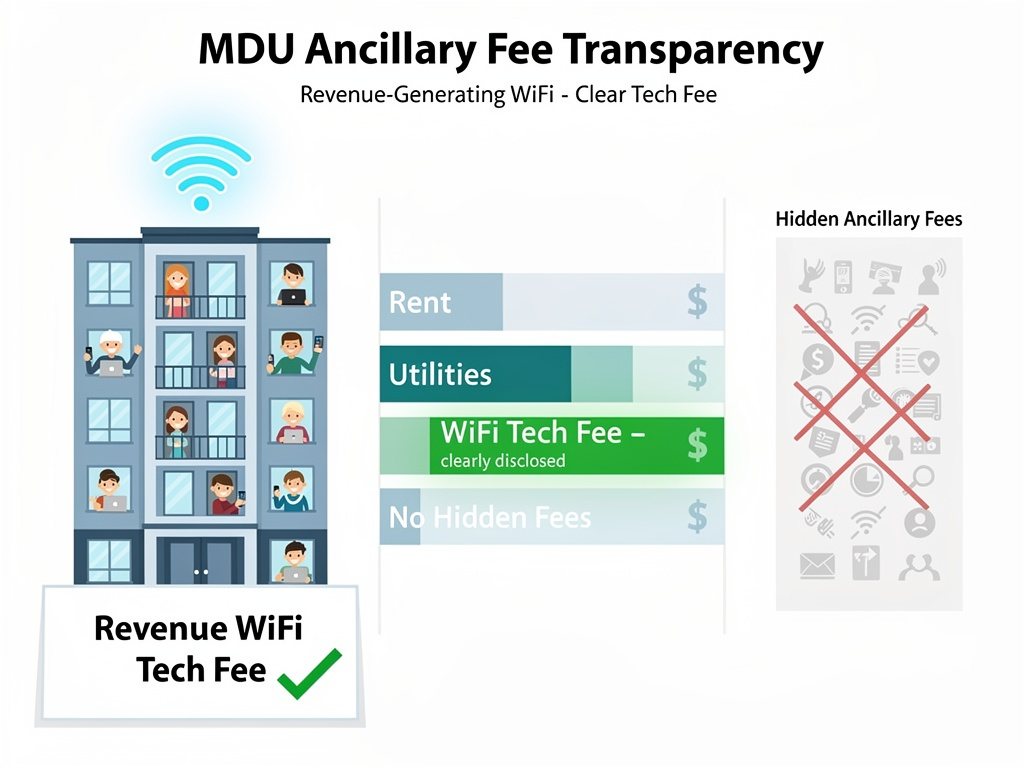
1. Disclosed Upfront Technology fees for property-wide WiFi are disclosed before residents sign leases. No surprises. No hidden charges. Residents know exactly what they're paying and why.
2. Documented Value What residents get: - Symmetrical fiber speeds (500+ Mbps upload/download) - Move-in ready connectivity (Day 1, no installation appointments) - 24/7 white-glove support (property never handles internet complaints) - Enterprise-grade reliability (99.9% uptime) - Property-wide roaming (pool, gym, parking lot, unit)
3. Eliminates Hidden Costs Residents don't pay $80-120/month for traditional ISP service. The technology fee replaces that expense with superior service at lower cost.
4. Solves a Real Daily Need Internet isn't optional in 2026. It's a utility. Residents use it for work, streaming, gaming, video calls, smart home devices, and daily life. Revenue-generating WiFi solves the #1 resident need while eliminating hassle.
NMHC's guidance reinforces what forward-thinking operators already know: residents don't resent fees for services that genuinely improve their living experience. They resent fees that feel extractive.
Case Study: The Haven at Chisholm Trail - Transparency in Action
The Haven at Chisholm Trail in Fort Worth, Texas, provides the perfect example of fee transparency done right.
The Model: - 328 units - Fiber-backed property-wide WiFi installed in 2019 - Mandatory technology fee disclosed as line item in rent statement - Residents knew upfront - no surprises, no hidden charges
The Results: - 90% resident adoption - Zero complaints to property management - $36.89/door monthly revenue - $145,000 annual ancillary income - $2.6 million property value increase at exit (November 2025)
Why Transparency Worked: When The Haven implemented this model, they were 100% transparent: - Residents knew about the technology fee before signing - The value was clear: Day 1 connectivity, superior speeds, 24/7 support - It replaced the need for residents to procure their own internet - The service delivered exactly what was promised
Result? 90% adoption. Zero complaints. $145K in annual revenue that institutional buyers valued at $2.6 million when Valiant Residential acquired the property in November 2025.
Transparency worked because the value was real.
The Three Pillars of Transparent Ancillary Income
Based on NMHC's framework and proven case studies like The Haven, sustainable ancillary income strategies require three pillars:
Pillar 1: Legitimate Infrastructure Investment Not junk fees. Real infrastructure with real costs: - Fiber installation (~$1,000/door average) - Enterprise-grade equipment - 24/7 support operations - Ongoing maintenance and upgrades
Properties that invest in infrastructure can transparently explain costs and value.
Pillar 2: Transparent Disclosure Upfront communication: - Disclose technology fees before signing - Explain what residents get - Show how it compares to traditional ISP costs - Make opting in/out clear (if optional) or explain why mandatory (like water/sewer)
Pillar 3: Documented Daily Value Tangible benefits residents experience: - Superior speeds (symmetrical fiber vs. asymmetrical cable) - Zero installation hassle (move-in ready) - White-glove support (24/7 help) - Lower total cost than traditional ISP - Property-wide roaming connectivity
When all three pillars exist, residents see the fee as fair value exchange—not a junk fee.
Implementation Framework: Building Fee-Transparent Ancillary Income
Property owners looking to implement revenue-generating WiFi while adhering to NMHC's fee transparency guidance should follow this framework:
Step 1: Choose Infrastructure Over Band-Aids Invest in fiber-backed property-wide WiFi, not just WiFi extenders or third-party cable ISP wholesale agreements. Fiber infrastructure: - Delivers symmetrical speeds (500+ Mbps up/down) - Supports future IoT and smart home integration - Provides enterprise-grade reliability - You own the asset (depreciation benefits)
Step 2: Disclose Early and Often In marketing materials: - "Move-in ready fiber-backed WiFi included" - "Technology fee: $X/month for [service description]"
In lease agreements: - Clear line item for technology fee - Explain what's included - Compare to traditional ISP costs
In resident onboarding: - Show residents how to connect Day 1 - Provide 24/7 support contact info - Set expectations for service quality
Step 3: Deliver on the Promise Ensure the service matches the marketing: - 99.9% network uptime - Fast support response times - Proactive issue resolution - Regular network upgrades
Step 4: Document Performance Track metrics for transparency: - Resident adoption rates - Support ticket volume (should be low) - Network uptime - Resident satisfaction scores
This documentation proves value to residents, investors, and future buyers.
Step 5: Communicate Value Continuously Don't assume residents remember what they're paying for: - Quarterly resident communications about network upgrades - Highlight 24/7 support availability - Compare speeds to traditional ISPs - Remind residents of move-in convenience
Transparent communication builds trust, which reduces fee resistance.
Addressing Common Objections: Fee Transparency Edition
Objection 1: "Residents will see this as a junk fee" Reality: Residents distinguish between junk fees (pool fees for pools they don't use) and legitimate services (internet they use daily).
The Haven's 90% adoption and zero complaints prove: When value is real and disclosed transparently, residents accept the fee.
Objection 2: "Fee transparency regulations will kill ancillary income" Reality: Fee transparency regulations target extractive junk fees, not legitimate infrastructure investments.
NMHC's guidance explicitly supports fees with clear value. Properties with transparent, value-delivering fees will thrive.
Objection 3: "Mandatory technology fees violate resident choice" Reality: Many services are mandatory in multifamily (water, sewer, trash). Residents don't opt out of those, and internet has become equally essential.
The key: Transparent disclosure. Residents who know upfront can choose whether to live there. That's informed consent.
Objection 4: "We'll lose residents over this fee" Reality: Residents are already paying $80-120/month for traditional ISP service. A $40-65/month technology fee that delivers superior service and zero hassle is a value proposition.
The Haven's 90% adoption proves: Residents choose properties with transparent, value-add fees.
The Future of Ancillary Income: Transparency is the Competitive Advantage
As regulatory scrutiny on junk fees increases and fee transparency becomes standard practice, property owners face a fork in the road:
Path 1: Extractive Fees Continue charging residents for pools, gyms, and amenities that already exist. Face resident pushback, regulatory pressure, and reputation damage.
Path 2: Value-Add Infrastructure Invest in legitimate infrastructure (fiber-backed WiFi, smart building tech) that generates ancillary income while solving resident pain points. Build resident trust through transparent disclosure.
The properties that thrive in 2026 and beyond will be those that choose Path 2.
Why Fee Transparency Makes Revenue-Generating WiFi Stronger
Here's the counterintuitive truth: Fee transparency doesn't hurt revenue-generating WiFi strategies—it strengthens them.
Properties with extractive junk fees will face scrutiny. Properties with transparent, value-delivering technology fees will benefit from the distinction.
The Competitive Advantage: When institutional buyers evaluate properties, they'll ask: - "What ancillary income streams exist?" - "Are these fees defensible under new transparency regulations?" - "Will residents accept these fees?"
Properties with transparent WiFi revenue models will have clear answers: - Yes, we have documented ancillary income ($30-50/door monthly) - Yes, fees are transparent and value-delivering - Yes, residents adopt at 90%+ rates
Properties with extractive junk fees won't have these answers.
Conclusion: The Roadmap Forward
NMHC's December 2025 guidance on fee transparency isn't a barrier to ancillary income—it's a filter that separates legitimate value-add strategies from extractive junk fees.
Revenue-generating fiber-backed WiFi infrastructure passes this filter with flying colors: - ✅ Transparent disclosure upfront - ✅ Documented daily value - ✅ Solves real resident pain point - ✅ Delivers superior service at lower cost - ✅ Generates sustainable ancillary income
The question for property owners evaluating ancillary income strategies:
Can you transparently explain what residents get for the fee? Is the value documentable? Does it solve a real daily need?
If yes, fee transparency is your roadmap. If no, it's a warning.
Legitimate infrastructure investment + transparent disclosure = sustainable ancillary income.
Which side of that filter is your approach?
Take the Next Step
Ready to implement a fee-transparent, revenue-generating WiFi strategy at your property?
Fiber Stream specializes in helping multifamily property owners: - Install fiber-backed property-wide WiFi infrastructure - Generate $30-50/door monthly in ancillary income - Achieve 90%+ resident adoption rates - Build fee transparency into the model from day one - Document performance for exit value maximization
Learn more: - Website: https://www.fiberstreamwifi.com - Revenue Guide: https://gamma.app/docs/Guide-to-Revenue-Generating-Fiber-Backed-WiFi-Ancillary-Income-qojuk1ee9lbabbq - Case Study: Read about The Haven at Chisholm Trail's $2.6M exit value increase
Contact us for a custom property assessment and revenue projection.
Fee transparency isn't the enemy of ancillary income—it's the foundation for sustainable, resident-trusted revenue streams that increase property value at exit.
About Fiber Stream: Headquartered in Phoenix, Arizona, Fiber Stream is a nationwide provider of enterprise-grade revenue-generating WiFi and complete technology solutions for multifamily properties. We help property owners transform internet from an expense into an asset while building resident trust through transparent, value-delivering service models.
Related Resources:
[How Revenue-Generating WiFi Adds Property Value]( https://www.multifamilyinsiders.com)
[The Complete Guide to Ancillary Income]( https://gamma.app/docs/Guide-to-Revenue-Generating-Fiber-Backed-WiFi-Ancillary-Income-qojuk1ee9lbabbq)
[Mark Allen Podcast: Fiber Stream Discussion]( https://podcasts.apple.com/us/podcast/ep-29-fiber-stream/id1215990037?i=1000440834963)
Revenue & ROI
Related from Fiber Stream
- Property-wide WiFiThe managed amenity behind the revenue
- Get A QuoteDoor count in, revenue projection back
- More Revenue & ROI articles
Want this working at your property?
Send us your door count and we'll return a quote with a revenue projection.
Get a quote